
For decades, leadership success was defined by work hours, control, and sacrifice. Be visible. Be decisive. Push harder. Outwork everyone else.
That model worked when work was predictable, attention was protected, and recovery happened naturally outside the office.
That world no longer exists.
Hybrid work blurred boundaries between effort and rest. Cognitive demands multiplied. Decision cycles accelerated. Burnout stopped being an exception and became a constant risk.
We’re seeing this across organizations, not just theorizing about it. And yet, many leaders are still running the same old playbook.
Here’s the hard truth: The old rules of leadership haven’t kept pace with how work actually works now.
The leaders thriving today aren’t the ones pushing harder or demanding more hours. They’re the ones designing environments where people can focus deeply, recover intentionally, and challenge ideas without fear.
This is the next evolution of leadership.
And it’s built on three performance levers that elite performers have understood for decades:
- Psychological safety: the engine of honest thinking and collaboration
- Flow state: the conditions where great work happens, and actually feels good
- Load management: the ability to balance effort and recovery to sustain performance over time
These go beyond soft skills and perks. They’re the true pillars of modern workplace performance.
What follows are the new rules of leadership — and what it actually takes to lead well in 2026 and beyond.
Rule #1: Psychological Safety Is the Foundation of Performance
Psychological safety at work means employees can speak up, challenge ideas, and admit uncertainty without the risk of punishment, embarrassment, or career damage.
It’s one of the most discussed leadership topics of the last decade. It’s also one of the most misunderstood.
Psychological safety isn’t a feel-good initiative designed to make work more comfortable. And it certainly isn’t about lowering standards or avoiding accountability.
At its core, psychological safety is about permission to tell the truth. Especially when that truth is inconvenient, incomplete, or disruptive.
Without psychological safety, performance becomes fragile.
Teams may appear aligned, but they self-censor. Decisions feel efficient, right up until they fail under pressure. Problems seem to smooth over, but they simply go unspoken until the cost of silence is far higher than the cost of dissent.
Modern work requires judgment, creativity, and shared sensemaking. Because of that, psychological safety is the bedrock of your organization. When people don’t feel safe to speak honestly, organizations lose access to their own intelligence.
In psychologically unsafe environments, employees spend cognitive energy managing impressions rather than solving problems. That’s an invisible tax on your entire team that drains energy, slows learning, and quietly erodes trust.
Why Psychological Safety Comes First
Psychological safety is the condition that makes every other performance behavior possible.
Without psychological safety:
- Focus becomes fragile because people are constantly scanning for social and political risk
- Flow is disrupted by fear of being wrong or being seen as disagreeable
- Load management breaks down, because rest looks like weakness
- Innovation stalls, because challenge feels unsafe
In unsafe environments, people don’t stop thinking. They just stop sharing what they think.
That silence is costly.
Ideas go untested. Risks surface too late. Leaders mistake speed for clarity and agreement for alignment. Over time, the organization becomes less adaptive, less resilient, and more exposed to failure.
The Levels of Psychological Safety at Work
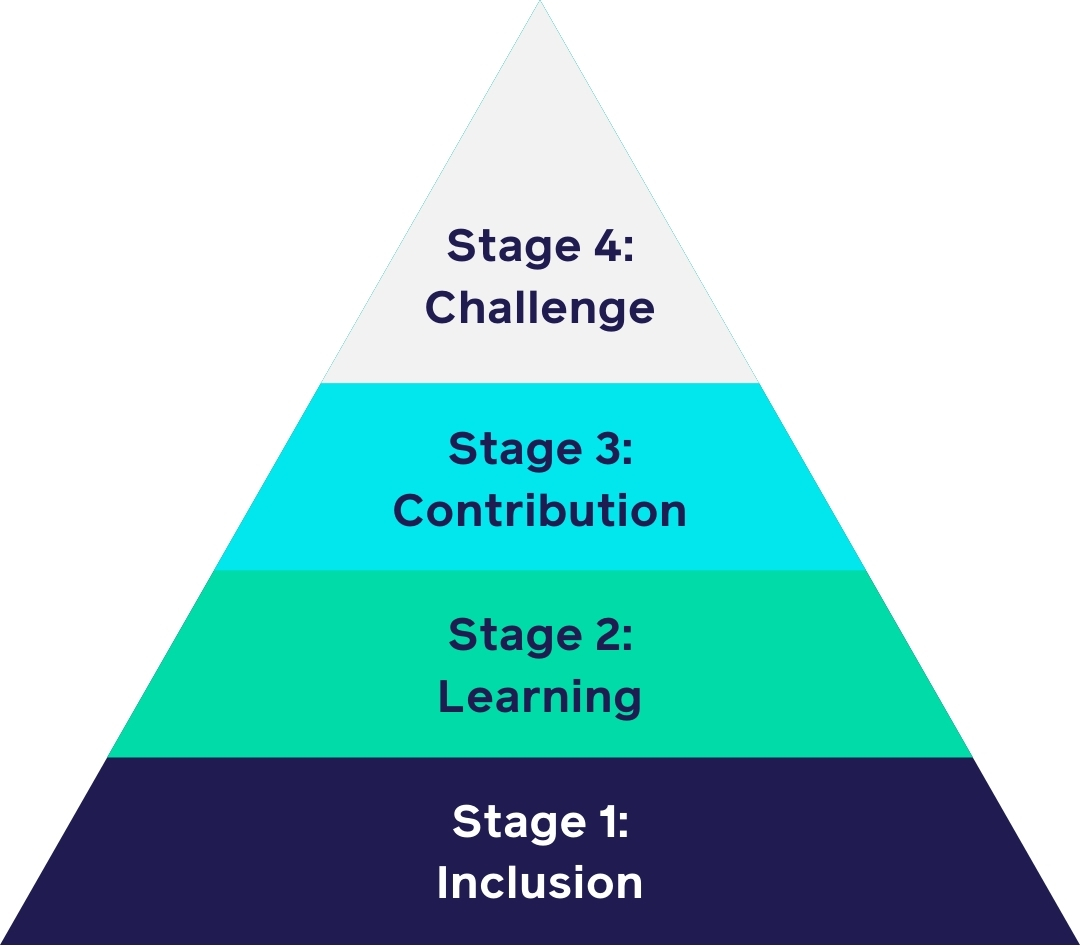
Psychological safety isn’t binary. Teams don’t simply “have it or not.” It develops in levels. And understanding those levels helps leaders diagnose where safety breaks down and why dissent often disappears before performance does.
Psych Safety Stage 1: Inclusion
The inclusion stage is the feeling of belonging. I.e., you’re accepted and respected as part of the team. Without inclusion, people conserve energy, stay quiet, and avoid risk from the start.
Psych Safety Stage 2: Learning
As safety strengthens, teams enter a learning phase. Questions feel safer. Uncertainty can be admitted. Mistakes are treated as part of the learning process rather than as liabilities. Curiosity increases, experimentation improves, and teams adapt faster because learning isn’t punished.
Psych Safety Stage 3: Contribution
At the contribution level, people feel safe to apply their skills, share ideas, and do meaningful work. Capability turns into contribution, and engagement rises as people see their input valued.
Psych Safety Stage 4: Challenge
The highest and most fragile level of psychological safety is the safety to challenge. This is where people feel safe to question decisions, challenge assumptions, and push back on authority. Challenger safety is where productive dissent lives.
In our performance culture consulting work, we find that many organizations stall here without support. Psychological safety is often embraced right up until it threatens speed, hierarchy, or the illusion of agreement. This stall isn’t a failure of intent or leadership capability. It’s a predictable response in systems built to prioritize efficiency and control.
They achieve inclusion and even learning, but stop short of real challenge. That’s why dissent is such a powerful signal: When people stop questioning ideas, psychological safety hasn’t vanished entirely. It’s just plateaued.
High-performing leaders intentionally build all four levels, knowing that the ability to dissent safely is the clearest marker of true psychological safety.
The Strongest Marker of Psychological Safety: Productive Dissent
Many organizations attempt to assess psychological safety through surveys or engagement scores. While useful, these measures often lag behind reality.
The most reliable, observable marker of psychological safety is productive dissent.
When people can disagree openly, especially between ranks, psychological safety is present.
When dissent disappears, decision quality quietly degrades. Assumptions go untested, risks surface late, and leaders mistake alignment for accuracy. What looks like efficiency in the moment often becomes delayed failure down the line. In this sense, productive dissent isn’t a cultural preference. It’s a form of risk management.
Productive dissent is not conflict for conflict’s sake. It is a respectful, focused challenge aimed at improving decisions, strengthening strategy, and reducing risk.
It shows up when teams:
- Question assumptions before they become failures
- Raise risks early instead of after the fact
- Debate ideas without attacking people
- Offer alternative perspectives even when it slows the room down
Dissent doesn’t create psychological safety. Psychological safety enables dissent.
Leaders who understand this stop asking, “Why won’t my team speak up?” and start asking, “What am I doing, intentionally or unintentionally, that makes other people believe that speaking up is risky?”
How Leaders Build Psychological Safety in Practice
Psychological safety is not built through slogans, values statements, or one-time workshops. It is built (or broken) through daily leadership behaviors.
Leaders who consistently create psychological safety:
- Invite challenge and respond with curiosity rather than defensiveness
- Separate ideas from identity, attacking problems instead of people
- Reward honesty even when it complicates decisions
- Change their minds when better information emerges
- Admit mistakes publicly, while taking responsibility and committing to improvement
Crucially, strong leaders model dissent themselves.
When leaders question their own assumptions, acknowledge blind spots, and invite disagreement, teams learn that truth matters more than ego.
Exos POV: When teams stop disagreeing, you’re not seeing harmony. You’re seeing self-protection. Psychological safety shows up when people are willing to risk discomfort to improve the work. The question is where that discomfort becomes unsafe — and what signals the organization sends in those moments.
Rule #2: Leaders Must Design for Flow
When was the last time you were so absorbed in a task that every thought flowed effortlessly into the next?
Or when time seemed to disappear, and your work felt challenging but light — demanding yet energizing?
Those moments come from flow state.
Flow state is what people often describe as being “in the zone.” It feels almost magical. But it is not accidental.
Flow is also often described as a personal state. But in organizations, it’s largely a structural outcome. People don’t fail to focus because they lack discipline. They struggle because the environment around them fragments attention.
How often your employees can reach flow reflects how work is designed: how priorities are set, how decisions move, and how frequently attention is redirected.
We know the science behind flow. And with the right leadership behaviors and organizational design, flow can be supported intentionally.
Why Flow Matters for Modern Work
Flow is not just a mental high. It is a temporary state of being that allows people to perform beyond their usual capacity while feeling fulfilled, engaged, and healthy.
In flow, the brain becomes more efficient. Distractions fade. Feedback loops tighten. People make better decisions faster. And this isn’t because they rush, but because their attention is fully aligned with the task at hand.
When organizations create more opportunities for flow, they unlock tangible benefits:
- Greater performance: People produce higher-quality work in less time
- Increased creativity: Ideas build naturally on one another, improving innovation
- Higher engagement: Work feels meaningful rather than draining
- Long-term development: Skills compound without burnout
Flow is how great work actually gets done.
The Flow Cycle: How Flow State Really Works
Flow state follows a predictable cycle.
You might not expect it, but flow begins with struggle. Productive struggle triggers focus and engagement as the brain responds to challenges. Without challenge, the brain never fully engages.
Leader takeaway: Help your team members take on opportunities that stretch them.
As effort is sustained, the stress from struggle subsides. Motivation increases, and creative insight becomes more accessible. Work begins to feel lighter as ideas connect more fluidly.
Then comes the flow state itself. The mind is relaxed but sharply focused. Self-consciousness fades. Time distorts. Creativity and execution peak simultaneously.
Leader takeaway: Support your team in setting aside time for deep work to enter flow state.
Finally, recovery allows the cycle to repeat. Flow is energy-intensive, and without recovery, it becomes inaccessible. This is where flow connects directly to load management.
Leader takeaway: Champion a culture of recovery, and encourage others to do the same. If possible, design policies that support employee recovery across the organization.
Why Flow Has Become So Rare
Despite its benefits, flow is increasingly scarce at work.
Meeting-heavy calendars, constant interruptions, unclear priorities, and pressure to multitask fragment attention. Even highly motivated, talented people struggle to reach flow when their focus is repeatedly broken.
Flow requires:
- Clear goals and priorities
- Minimal distractions and task switching
- A balance between challenge and skill
- Autonomy over how work gets done
- Uninterrupted time to think
Leaders can directly influence all of these conditions, for better or for worse.
How Leaders Help Teams Get Into Flow
Leaders help teams get into a flow state by:
- Protecting blocks of uninterrupted work time
- Clarifying priorities and success criteria
- Reducing unnecessary meetings and notifications
- Encouraging single-task focus instead of multitasking
- Modeling focus-friendly behaviors themselves
Creating a flow-friendly work environment doesn’t reduce accountability. It raises the quality of thinking behind the work.
When leaders design for flow, they don’t just get more output. They get better judgment, deeper creativity, and work people are proud of. Better yet, their employees actually feel good and motivated for years to come.
Exos POV: If your calendar looks like a game of Tetris, you’re leading in the wrong direction. Flow requires space for sustained attention, not constant availability. The real choice is whether the organization is designed to protect focus, or quietly trade it for speed.
Rule #3: Load Management Is a Leadership Responsibility
When people hear the term load management, they often think of professional athletes sitting out of games. In reality, it’s about balancing training, recovery, and competition to peak at the right moment.
The modern workplace isn’t all that different.
Modern work now demands sustained mental exertion, emotional regulation, and rapid decision-making under pressure. And many teams rush from one intense demand to the next without intentional recovery or capacity-building in between.
Load management is the practice of understanding when to push, when to pause, and how to build the capacity required to perform consistently over time.
Load management is often dismissed as coddling or a signal that standards are slipping. It’s understandable why people feel that way: For years, visible effort and long hours were reliable proxies for commitment and productivity. But as work has become more cognitive and less mechanical, those proxies have broken down.
Managing load isn’t about lowering expectations. It’s about protecting the conditions required for sound judgment and consistent execution — especially when the work itself is complex and high-stakes.
Load management isn’t about doing less work. It’s about doing work more intelligently.
Why Load Management Outperforms Time Management
Time management will always matter. But time alone doesn’t create performance.
If you have time but no energy, focus, or emotional regulation, that time is largely useless. Load management helps your team make the most of their time.
Humans operate in natural rhythms of energy and attention. When people try to ignore those rhythms to max out effort without recovery, their performance naturally degrades.
Load management recognizes that performance is not about maximizing effort every day. It is about strategically allocating energy across time.
Think of Load Management as Your Energy Bank Account
Load management works a lot like managing a bank account.
Consistent withdrawals without deposits create energy debt. And energy debt, like financial debt, accrues interest.
Preventing exhaustion is far more effective than recovering from it.
When effort and recovery are balanced intentionally, people build energy reserves that allow them to perform well during intense periods without breaking down.
Practical Load Management Across Time Horizons
Load management must be designed across multiple time scales.
Weekly:
- Balance effort with breaks
- Protect focus time and respect others’ work boundaries
- Encourage micro-recovery between meetings
Quarterly:
- Plan recovery after major sprints
- Adjust workloads intentionally
- Reflect on what created unnecessary strain
Yearly:
- Anticipate peak demand
- Narrow focus during crunch periods
- Build organization-wide recovery windows
Load management doesn’t eliminate ambition. It protects it.
When leaders manage load well, they reduce burnout, improve decision quality, and make sustained performance possible.
Exos POV: Leaders aren’t responsible for eliminating load. They are responsible for helping their teams manage it. The real question is whether effort and recovery are actually balanced, or quietly pushing the organization toward breakdown.
How Psychological Safety, Flow, and Load Management Work Together
These three conditions form an integrated performance system:
- Psychological safety enables honest thinking and dissent.
- Flow turns that thinking into high-quality work.
- Load management sustains performance over time.
Together, they create teams that are sharper, healthier, more resilient, and more innovative.
Remove any one of them, and performance degrades.
Leadership is About Designing Better, Not Pushing Harder
These new rules of leadership are simple to name, but not simple to apply. Every organization carries its own history, pressures, and tradeoffs. And designing for psychological safety, flow, and load management looks different in each context.
Exos works with leaders to think through how these principles translate into daily reality. Not with a one-size-fits-all playbook, but through honest diagnosis, practical experimentation, and an understanding that sustainable performance is built over time.
The work isn’t about pushing harder or copying what worked somewhere else. It’s about designing conditions that fit the organization you’re leading, and then evolving them as the work evolves.
If this approach resonates with you, let’s continue the conversation. Talk to an Exos representative today to bring the new rules of leadership to life at your organization.
About the Expert
Stefan Underwood, MS, CSCS, is Exos’ Senior Vice President of Methodology and a recognized authority on human performance. He holds a BSc in Exercise Science and a MS in Organizational Psychology. With 20 years of coaching elite athletes, Special Operations Forces, and Fortune 500 leaders, he helps turn human potential into peak organizational results. Stefan leads Exos’ multidisciplinary Performance Innovation Team and teaches cutting-edge methods worldwide through Exos Education.
.png?width=282&name=Featured%20Image%20(2).png)